
Systematic Literature Review and Meta-Analysis Services for Researchers
By Paperza Editorial Team
|
19 Oct 2026
|
13 min read
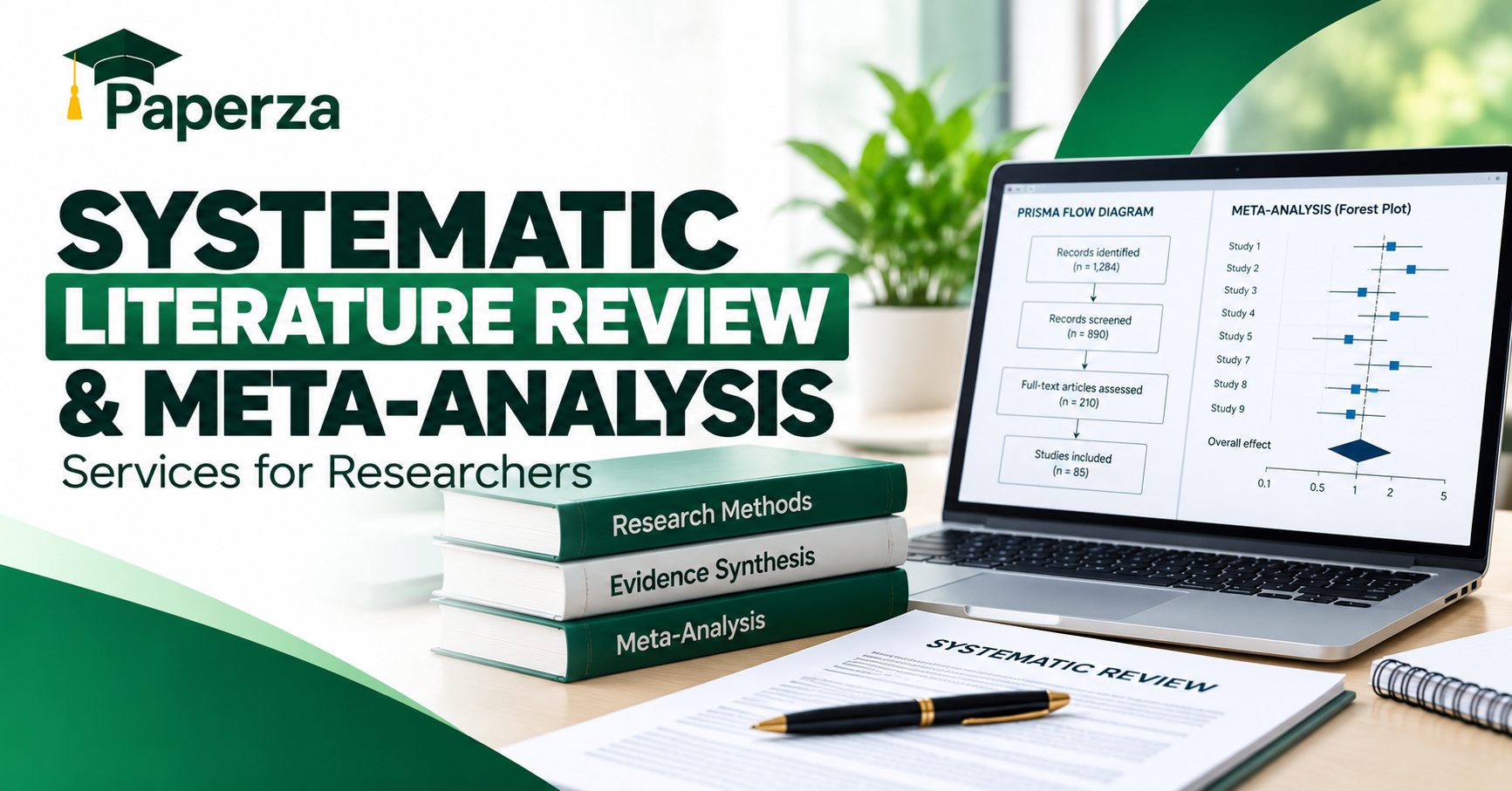
Systematic Literature Review and Meta-Analysis Services for Researchers
Conducting a systematic literature review or meta-analysis can be one of the most demanding stages of academic research. From identifying relevant publications and screening hundreds of studies to extracting data, evaluating research quality, and conducting statistical analysis, the process requires careful planning and methodological accuracy.
For postgraduate students, PhD candidates, academic researchers, healthcare professionals, and research institutions, completing a systematic review can take considerable time, especially when preparing a thesis, dissertation, journal manuscript, or research project.
Professional systematic literature review and meta-analysis services can help researchers manage these complex tasks while maintaining transparency, accuracy, and compliance with established research standards.
At Paperza, we provide systematic literature review assistance, meta-analysis support, PRISMA 2020 reporting, literature searches, study screening, data extraction, evidence synthesis, and statistical analysis.
Whether you are beginning a systematic review or need assistance completing specific research tasks, our services are designed to support your research objectives and publication requirements.
What Are Systematic Literature Review Services?
A systematic literature review is a structured research method used to identify, evaluate, and synthesize available evidence addressing a clearly defined research question.
Unlike a traditional literature review, a systematic review follows a documented methodology intended to reduce bias and improve transparency.
The process typically involves:
- Developing a focused research question.
- Establishing inclusion and exclusion criteria.
- Designing a reproducible literature search strategy.
- Searching relevant academic databases.
- Screening titles, abstracts, and full-text articles.
- Extracting relevant research data.
- Assessing study quality and risk of bias.
- Synthesizing research findings.
- Preparing a systematic review manuscript.
- Reporting methods and results using appropriate guidelines.
Professional systematic review assistance can help researchers organize these stages and prepare accurate research documentation.
If you need assistance planning or conducting a systematic review, explore Paperza's academic research support services.
What Is Meta-Analysis in Academic Research?
Meta-analysis is a statistical technique used to combine quantitative results from multiple studies addressing a related research question.
Instead of relying on the findings of one study, meta-analysis estimates an overall effect using evidence from several eligible studies.
For example, a healthcare researcher may conduct a meta-analysis to evaluate the effectiveness of a particular treatment across multiple clinical trials.
Similarly, researchers in psychology, education, business, engineering, and social sciences may use meta-analysis to examine relationships, interventions, or outcomes reported across different studies.
Meta-analysis commonly involves:
- Identifying eligible quantitative studies.
- Extracting effect sizes and statistical information.
- Selecting appropriate statistical models.
- Calculating pooled effect estimates.
- Assessing statistical heterogeneity.
- Performing subgroup or sensitivity analyses.
- Evaluating potential publication bias.
- Creating forest plots and funnel plots.
- Interpreting statistical findings.
Not every systematic review requires a meta-analysis. Statistical pooling is appropriate only when the available studies provide sufficiently compatible data and the analysis is methodologically justified.
Who Needs Systematic Literature Review and Meta-Analysis Services?
Systematic reviews are widely used across academic and professional research disciplines.
1. PhD and Doctoral Researchers
Doctoral researchers may conduct systematic reviews to identify research gaps, evaluate existing evidence, and establish the foundation for original research.
Professional assistance can support literature searching, screening, evidence synthesis, methodology development, and reporting.
2. Master's Students
Postgraduate students may need systematic review support when preparing dissertations, research projects, or publication manuscripts.
Assistance with database searches, reference management, and data extraction can help students manage the technical components of their research.
3. Healthcare and Medical Researchers
Systematic reviews and meta-analyses are frequently used in medicine, nursing, public health, pharmacy, and related healthcare disciplines.
These projects may involve clinical trials, observational studies, intervention outcomes, diagnostic accuracy, and healthcare policy.
4. Academic Researchers and University Faculty
University researchers may conduct systematic reviews to support journal publications, research collaborations, policy recommendations, and grant-funded projects.
5. Research Institutions and Organizations
Research institutions, NGOs, consulting organizations, and policy groups may use systematic evidence synthesis to evaluate programs, identify best practices, and support evidence-informed decisions.
Our Systematic Literature Review Services
Paperza provides research assistance across the different stages of systematic literature reviews.
1. Research Question Development
A clearly defined research question is essential for a systematic review.
We assist researchers in refining research questions and identifying appropriate frameworks, including:
- PICO: Population, Intervention, Comparison, Outcome.
- PICOS: Population, Intervention, Comparison, Outcome, Study Design.
- PEO: Population, Exposure, Outcome.
- SPIDER: Sample, Phenomenon of Interest, Design, Evaluation, Research Type.
The most suitable framework depends on the research discipline and objectives.
2. Literature Search and Database Research
A comprehensive literature search helps identify relevant studies and reduce the risk of missing important evidence.
Depending on the research topic and available access, searches may involve databases such as:
- PubMed/MEDLINE.
- Scopus.
- Web of Science.
- Embase.
- Cochrane Library.
- IEEE Xplore.
- ScienceDirect.
- PsycINFO.
- CINAHL.
We help researchers develop search terms, Boolean search strings, keyword combinations, and documented search strategies.
Database access and the availability of full-text publications depend on the client's subscriptions and other lawful access arrangements.
3. Study Screening and Selection
After identifying potentially relevant publications, studies must be screened against predefined eligibility criteria.
This may involve:
- Removing duplicate records.
- Screening article titles.
- Reviewing abstracts.
- Evaluating full-text publications.
- Recording exclusion reasons.
- Organizing eligible studies.
We help researchers document screening decisions and maintain organized study-selection records.
Where independent screening is required, reviewer roles and procedures should be agreed upon in advance.
4. PRISMA 2020 Flow Diagram Preparation
The Preferred Reporting Items for Systematic Reviews and Meta-Analyses (PRISMA) 2020 statement provides reporting guidance for systematic reviews.
A PRISMA flow diagram presents the number of records identified, screened, excluded, and included.
Paperza can assist with preparing PRISMA 2020 flow diagrams using documented study-selection information.
The diagram should accurately reflect the actual review process and should not contain invented screening figures.
5. Data Extraction and Evidence Organization
Data extraction involves collecting relevant information from eligible studies.
Depending on the review, extracted information may include:
- Author names and publication years.
- Study locations.
- Research objectives.
- Study designs.
- Sample sizes.
- Participant characteristics.
- Interventions and comparison groups.
- Outcome measures.
- Statistical results.
- Main findings.
- Study limitations.
We help researchers develop structured extraction tables using Excel or other appropriate tools.
6. Risk-of-Bias and Quality Assessment
Assessing the quality and limitations of included studies is an important part of evidence synthesis.
Depending on the research design, relevant tools may include:
- Cochrane RoB 2.
- ROBINS-I.
- Newcastle–Ottawa Scale.
- Joanna Briggs Institute appraisal tools.
- QUADAS-2.
The selected assessment method should match the study designs and research objectives.
Paperza provides assistance with organizing and documenting quality assessments based on the applicable framework.
7. Narrative Synthesis
When studies cannot be combined statistically, researchers may use narrative synthesis to summarize and compare findings.
Narrative synthesis can help identify:
- Common research themes.
- Differences between study findings.
- Patterns across populations or settings.
- Methodological limitations.
- Research gaps.
- Implications for future studies.
We help researchers organize evidence into coherent summaries supported by the included publications.
Professional Meta-Analysis and Statistical Analysis Services
For systematic reviews that require quantitative evidence synthesis, Paperza provides meta-analysis support using appropriate statistical methods.
Effect Size Calculation
Effect sizes describe the magnitude of an association, difference, or intervention effect.
Common effect measures include:
- Odds ratios.
- Risk ratios.
- Mean differences.
- Standardized mean differences.
- Hazard ratios.
- Correlation coefficients.
The appropriate effect measure depends on the research question and the data reported in eligible studies.
Fixed-Effect and Random-Effects Models
Meta-analysis may use fixed-effect or random-effects models.
A fixed-effect model assumes that the included studies estimate one common underlying effect.
A random-effects model allows the underlying effects to vary across studies.
Model selection should be justified by the research question, study characteristics, and statistical assumptions rather than chosen solely because of a heterogeneity test.
Heterogeneity Assessment
Heterogeneity refers to variation between study findings.
Researchers may assess heterogeneity using measures such as:
- I² statistic.
- Cochran's Q statistic.
- Tau-squared (τ²).
These measures help researchers understand differences between studies and evaluate the interpretation of pooled results.
Forest Plot Preparation
A forest plot visually displays effect estimates and confidence intervals for individual studies.
When appropriate, it also presents the pooled effect estimate.
Forest plots help readers understand the direction, magnitude, and precision of study findings.
Funnel Plot Analysis
Funnel plots may help researchers explore small-study effects and possible publication bias.
However, funnel plot interpretation depends on the number of studies and other methodological considerations.
A funnel plot alone cannot establish whether publication bias exists.
Subgroup and Sensitivity Analysis
Where appropriate, subgroup analyses can explore differences between categories of studies.
Sensitivity analyses examine how conclusions change when specific assumptions, studies, or analytical decisions are modified.
These analyses should be justified and interpreted carefully.
Need assistance with statistical pooling, forest plots, or evidence synthesis? Explore Paperza's research data analysis services for support with appropriate statistical methods and interpretation.
Software Used for Systematic Reviews and Meta-Analysis
Different software applications support different stages of the review process.
| Software | Common applications |
| R | Meta-analysis, statistical modeling, forest plots, sensitivity analysis |
| Python | Data processing, statistical analysis, automation |
| SPSS | Statistical analysis and data management |
| Excel | Study screening records, extraction tables, data organization |
| RevMan | Cochrane-style systematic review and meta-analysis workflows |
| Rayyan | Literature screening and collaboration |
| Zotero | Reference management and citation organization |
| EndNote | Reference management and manuscript citations |
The choice of software depends on the project's methodology, available data, and reporting requirements.
Our Systematic Review and Meta-Analysis Process
At Paperza, we follow a structured workflow tailored to each research project.
Step 1: Research Assessment
We review your research topic, objectives, eligibility criteria, existing materials, and required deliverables.
Step 2: Review Planning
We help organize the research question, review protocol, search strategy, and study-selection criteria.
Where applicable, researchers should consider prospective protocol registration, such as PROSPERO for eligible reviews.
Step 3: Literature Searching
We assist with searching appropriate academic databases and documenting search results.
Step 4: Study Screening
Potentially eligible studies are reviewed according to predefined inclusion and exclusion criteria.
Step 5: Data Extraction
Relevant study characteristics and findings are organized into structured tables.
Step 6: Evidence Synthesis
We assist with narrative synthesis or statistical meta-analysis, depending on the available evidence and research design.
Step 7: Reporting and Quality Review
We help prepare relevant tables, figures, methodological documentation, and reporting materials.
Step 8: Final Delivery
The agreed research materials, analysis files, tables, and reports are delivered for the client's review.
How Much Do Systematic Literature Review and Meta-Analysis Services Cost?
The cost depends on the number of studies, research complexity, database searching requirements, statistical methods, and expected deliverables.
Paperza offers three service levels.
| Package | Starting price | Services |
| Basic | $100 | Literature searching, screening up to 50 records, organized references |
| Standard | $250 | Screening up to 150 records, extraction of 10 studies, PRISMA diagram, narrative synthesis |
| Premium | $500 | Screening up to 250 records, extraction of 20 studies, risk-of-bias support, meta-analysis where feasible |
These are starting package prices. Larger reviews, complex statistical models, multiple outcomes, or additional deliverables may require a customized quotation.
The feasibility of a meta-analysis depends on the available data, not simply the selected package.
Common Mistakes in Systematic Literature Reviews
Researchers should avoid several methodological problems that can reduce the reliability of a systematic review.
1. Using an Unclear Research Question
A poorly defined question can lead to inconsistent search strategies and inappropriate study selection.
2. Searching Too Few Databases
Depending on the topic, relying on one database may omit relevant evidence.
3. Changing Eligibility Criteria Without Documentation
Unexplained changes to inclusion or exclusion criteria can introduce bias.
4. Failing to Record Screening Decisions
A transparent review should document how studies were identified and selected.
5. Ignoring Risk of Bias
A large number of studies does not automatically mean that the evidence is reliable.
6. Combining Incompatible Studies
Statistically pooling studies with unsuitable designs, outcomes, or effect measures can produce misleading conclusions.
7. Misinterpreting Statistical Significance
Statistical significance should not be confused with practical or clinical importance.
8. Incomplete PRISMA Reporting
PRISMA reporting should accurately describe the methods and findings of the review.
Researchers should use the relevant reporting checklist and provide sufficient information for readers to understand the process.
Why Choose Paperza for Systematic Review and Meta-Analysis Support?
Systematic reviews require methodological consistency, careful data management, and accurate reporting.
Paperza supports researchers through services designed around these requirements.
Our assistance includes:
- Structured literature search strategies.
- Organized study screening and selection.
- PRISMA 2020 reporting support.
- Data extraction and evidence tables.
- Risk-of-bias assessment support.
- Narrative evidence synthesis.
- Statistical meta-analysis where appropriate.
- Forest plots and other relevant visualizations.
- Academic editing and manuscript formatting.
- Confidential handling of research materials.
Our objective is to help researchers produce transparent, organized, and methodologically defensible research outputs.
We do not guarantee journal acceptance, predetermined statistical significance, or particular research conclusions.
For researchers preparing journal manuscripts, Paperza also offers academic editing and research manuscript support.
Frequently Asked Questions
Can I hire someone to help with a systematic literature review?
Yes. Researchers can obtain professional assistance with literature searching, screening, data extraction, statistical analysis, and reporting. The researcher should maintain appropriate oversight, follow institutional requirements, and disclose contributions where required.
Can you help with a systematic review for my PhD?
Yes. Paperza provides methodological and technical support for doctoral research projects, subject to your university's academic integrity rules.
Do you provide PRISMA 2020 flow diagrams?
Yes. We assist with PRISMA 2020 flow diagrams using actual search and screening records.
Can you perform a meta-analysis using R or SPSS?
Yes. We provide statistical analysis assistance using R, SPSS, Python, Excel, and other appropriate tools, depending on the data and analytical requirements.
How many studies are needed for a meta-analysis?
There is no universal minimum that applies to every meta-analysis. Feasibility depends on the research question, available effect estimates, compatibility of studies, and the intended analysis. Some methods require more studies than others.
Can you help with forest plots and funnel plots?
Yes. We provide forest plot preparation and funnel plot analysis when appropriate for the dataset and methodology.
What is the difference between a systematic review and a meta-analysis?
A systematic review identifies, evaluates, and synthesizes evidence using a structured methodology.
A meta-analysis statistically combines quantitative findings from eligible studies.
A systematic review may include a meta-analysis, but not every systematic review requires one.
Can you help if I have already collected the articles?
Yes. If you already have relevant publications, we can assess the existing materials and assist with the remaining tasks, such as screening, extraction, quality assessment, or evidence synthesis.
How long does a systematic review take?
The timeline depends on the research question, number of records, database access, screening requirements, and complexity of the analysis.
Small, well-defined projects may require several weeks, while comprehensive systematic reviews can take several months or longer.
Do you guarantee publication in a journal?
No. Journal acceptance depends on editorial evaluation, peer review, research quality, and the publisher's independent decisions.
Get Professional Systematic Literature Review and Meta-Analysis Assistance
A systematic literature review requires more than collecting research papers. It involves developing a transparent methodology, selecting relevant studies, evaluating evidence, and presenting findings accurately.
Whether you are a PhD researcher, postgraduate student, academic professional, or research institution, professional assistance can help you manage the technical and methodological requirements of your project.
At Paperza, we provide systematic literature review services, PRISMA 2020 support, literature screening, data extraction, risk-of-bias assessment assistance, narrative synthesis, and meta-analysis services.
Need help with your systematic literature review or meta-analysis? Visit Paperza.com to explore our research support service
I will assist with your systematic literature review and meta analysis
Systematic Literature Review & Meta-Analysis Services Need professional assistance with your systematic literature review or meta-analysis? I provide research support for...
View Related Service >NEED PROFESSIONAL ASSISTANCE?
I will assist with your systematic literature review and meta analysis
Systematic Literature Review & Meta-Analysis Services Need professional assistance with your systematic literature review or meta-analysis?...